By: Adriana Vega
Would you believe me if I told you that most of our universe is made out of something we can’t even see? It might sound strange, but it's true. After all, the matter that we know of, like stars and galaxies, makes up only 5% of the content in our universe! So, what makes up the remaining 95%?
Scientists have observed that the galaxies in our universe are rotating way faster than expected. They seem to be moving so fast, that not even gravity should be able to hold them together. In our solar system, planets closer to the Sun orbit faster, while those farther away move slower. The same was assumed about galaxies, with celestial bodies closer to the center spinning faster than those farther away from it. However, something strange was happening - the galaxies were holding together despite their speed. Because of this, they believed something is giving these galaxies the extra mass for gravity to hold them together. This unknown matter is called dark matter. Unlike regular matter, dark matter doesn’t interact with the electromagnetic force, meaning it doesn’t absorb, reflect, or emit light, making it invisible to us. For comparison, normal matter makes up everything we can see, either with our eyes or a telescope that detects light across different wavelengths.
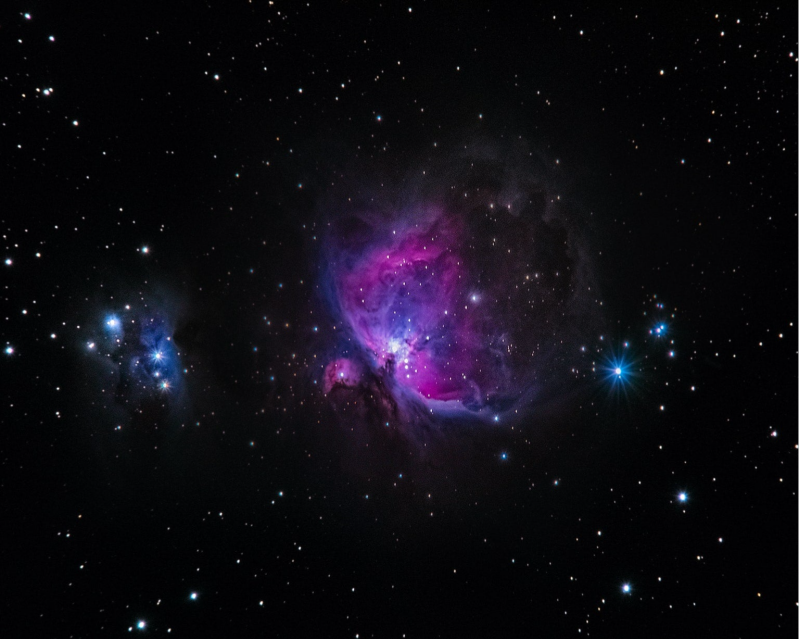
The term ‘dark matter’ was coined in the 1930s by Swiss astronomer Fritz Zwicky. While he was studying the Coma galaxy cluster, he noticed that the galaxies within it were moving faster than what should have been possible, given the visible mass. In the 1970s, U.S. astronomer Vera Rubin studied how individual galaxies rotated and confirmed the existence of dark matter, concluding that galaxies contain invisible mass.
Let’s not confuse dark matter with dark energy, as they are two different forces with opposite effects. Dark matter keeps the universe together, while dark energy pushes it apart. Quite the contradiction, huh?

In the late 1990s, astronomers discovered that the universe was expanding faster than gravity could hold it together, and that this expansion was only speeding up over time. Observations reveal that the universe was expanding at a slower rate in the past than it is now. Why is this? While the reason still remains unclear, it is believed that dark energy is a prime suspect. Think of dark energy as the opposite of gravity. This is called a repulsive gravitational effect, where dark energy pushes the universe apart instead of keeping it together. It may make up around 68% of the universe, but scientists know even less about dark energy than they do about dark matter.
Both of these are two of the biggest cosmological mysteries that remain unsolved, and the crazy thing is that they make up the vast majority of everything that exists! The mystery surrounding them reminds us of how much there is yet to discover about our universe, and, as technology advances and our methods of observation improve, we get one step closer to unraveling these enigmas. Until then, the search for answers continues - and by learning more, you can become part of that journey too.
Add comment
Comments