By: Zoey Salaj
Henrietta Lacks, an African-American woman whose cancer cells were taken without her consent in 1951 has left (and continues) to leave its mark on science. Her cells, known as HeLa cells, have been one of the most important tools in medicine. HeLa cells have been to space, were used for the COVID and polio vaccines, and even are utilized daily in testing for cosmetics like foundation and lipstick. Her cells have revolutionized science and have led to many breakthroughs. The scientific world would not be the same as it is today if not for her.
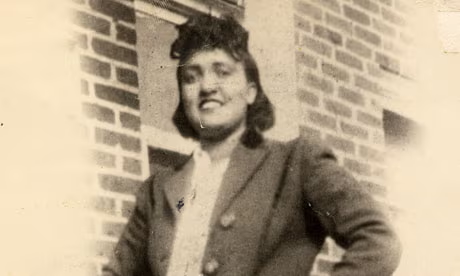
To begin, the reason why HeLa cells are so special is because they have the unique ability to survive and divide infinitely in a laboratory setting. The average human cell can divide only sixty times before cell death, but HeLa cells defy this norm. The immortality of HeLa cells gives scientists the ability to study human cells in ways that were not imagined before. For the first time in history, scientists had a consistent, renewable source of human cells to study.
A very famous experiment was conducted surrounding the observer effect in 1801 by British polymath Thomas Young titled the Double Slit Experiment. In this experiment, electrons are shot through two slits, creating an interference pattern (wave function) on a screen across. Though, when a detector is placed at the slits to see which slit the electrons go through, the electrons start behaving like particles, and the interference pattern disappears. In other words, by trying to observe the interference pattern, the electrons’ movements change entirely.
The observer effect stops us from being able to see many aspects of physics in action. The very act of looking can change what we see. Experiments like the Double Slit Experiment allow us to observe key principles of quantum mechanics in action.
Add comment
Comments